Thursday, March 15, 2012

Chick Webb


Happy Feet - Part 2
  
As Ella Fitzgerald’s fame grew, so there was a proportionate in­crease in the numbers of those claiming to have ‘discov­ered’ her. Among the claimants, and possibly more likely than most, is Bardu Ali, front man for the Chick Webb band. Whoever heard Ella first, Bardu Ali certainly took her along to meet his boss, who was impressed despite the fact that he didn’t need a singer, least of all one with no expe­rience. But Ella's voice captivated him and everyone in the band, and she was hired, at first being paid by Webb himself be­cause the band’s manager was notably unenthusiastic. Fitzgerald was only seventeen then and might well have considered herself lucky to have been hired by a man who was much more careful with her undeveloped talent than many other bandleaders might have been. Webb urged her to take things slowly, telling her. ‘There's lots to learn ... you never want to be some­one who goes up fast, because you come down the same way.’ Under Webb’s tutelage, Fitzgerald carefully developed her latent talent and, under his watchful eye, the band learned to respect her. Later, when Fitzgerald’s mother died, Webb and his wife Sallye be­came close to the youngster although whether or not Webb became Fitzgerald’s legally-appointed guardian remains questionable.


Although Fitzgerald’s first recordings for the band, I’ll Chase The Blues Away and Love And Kisses, which came in June 1935, were an inauspicious debut, a session in Oc­tober that same year brought Rhythm And Romance and other popular songs of the moment that were much better and by the following year, her contributions had become a significant part of the band’s recording sessions. One of these songs, If You Can’t Sing It, You’ll Have To Swing It (better known as Mr. Paganini), became very popular, as did A-Tisket, A-Tasket, a nonsense song for which the singer helped contribute the lyric. Apparently A­Tisket, A-Tasket was composed to bring some cheer to Chick Webb who was undergoing one of his periods of hospital­ization; certainly, the boost the record gave to the band’s bank balance must have helped everyone. Recorded early in 1939, Undecided is a better song and is superbly per­formed by Fitzgerald while Webb boosts the band into a dynamic performance. By this time, almost every record the band made was a vocal (only In The Groove At The Grove from the band’s 1939 released output is an instrumental), and no one was in any doubt about Fitzgerald’s vital role in the band’s success.

 
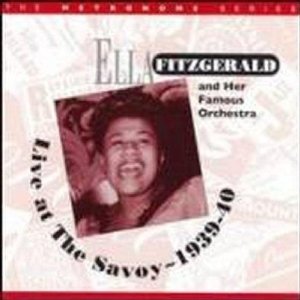
Sadly, however, time was running out for the leader of the band; frail and constantly in pain, Chick Webb was often unable to play at dance dates and a stand-in drummer took his place although he always strove to come onto the bandstand before the night was over. Deputizing for a musician of such legendary status was difficult and much credit is due to Bill Beason who accomplished this task with considerable skill. Indeed, he remained the band’s drummer when it later continued to play under the nominal leadership of Ella Fitzgerald. His considerable ability is well demonstrated on 1939-1940 airshots broadcast from the Savoy. Fortunately, some of these have been released by Hep Records:-


Chick Webb took the band on tour in mid-summer 1939 but was rushed to hospital when he collapsed while play­ing on a riverboat near Washington. At Johns Hopkins Hospital, where, only three decades earlier, he had undergone the operation that had enabled him to walk, he was diagnosed as suffering from pleurisy and a resurgence of tu­berculosis of the spine. Doctors decided that his condition was too grave to warrant further surgery, and he was taken to his parents’ home where he hung on for a week as friends and relatives gathered to support him in his last hours. On 16 June 1939, he asked to be raised up in his bed. He said, ‘I’m sorry. I gotta go,’ and died.


Assessing a musician’s place in jazz history on the basis of a few records and the reminiscences of not always im­partial observers is difficult. It would be an overstatement to suggest that Chick Webb’s band was on par with those of Duke Ellington, Count Basie, or Jimmie Lunceford, even though, on occa­sion, he matched and even defeated them in band battles at the Savoy. Nevertheless, a few such giants apart, there are not many bands that displayed so much uncluttered straight-ahead swing in performances that are liberally peppered with excellent hot solos. Undoubtedly, Webb’s was one of the best dozen or so big bands of its time.
As a drummer, Chick knew few peers, and even fewer betters. Listening to records in chronological sequence in an attempt to decide upon a drummer’s influence is a method of dubious accuracy, in part because the best jazzmen are always listening and sometimes pick up on ideas originated by their own followers. However, there is a notice­able change in big band drumming style in the mid-1930s that appears directly attributable to Chick Webb. By the end of the decade, another, perhaps greater, influence ap­pears with the work of Jo Jones and, to some extent, this has obscured the importance of Chick Webb in the devel­opment of big band drumming.

Setting aside rank and status, there is no doubt about the vitality and excitement of Webb’s band, and there is much enjoyment to be gained from listening to the band's recordings. Certainly, for eight glorious years, Chick Webb, King Of The Savoy, ensured that Harlem’s greatest ballroom truly was the home of happy feet.


Built in 1947, the Chick Webb Recreation Center on Eden Street in Baltimore, reflects the city’s pride in its former resident. Chick Webb is buried close to Baltimore at Arbutus Memorial Park.

Filmmaker Jeff Kaufman has recently completed The Savoy King: Chick Webb and the Music That Changed America.

The preceding originally appeared in slightly different form in Jazz Journal in March 1989. If you are not already a reader, their website is where you can subscribe.

Monday, March 12, 2012

Chick Webb

Happy Feet - Part 1

Right from its opening in 1926, the Savoy Ballroom on Lenox Av­enue between 140th and 141st Streets in Harlem, earned a reputation as the nation’s greatest dance center. The ballroom’s highly appropriate publicity tag was ‘The Home of Happy Feet’, although the ballroom’s regulars, amateurs often more skilful than the best professionals and who included Whitey’s Lindy Hoppers, referred to it affectionately as ‘The Track’.
Among the earlier bands that played at the Savoy was The Harlem Stompers, a medium-size group led by a diminutive drummer named Chick Webb. By 1931, now leading a big band, he had become a fixture at the ballroom and was soon regarded by the dancers as the undisputed King of the Savoy.


William Henry Webb was born in Baltimore, Mary­land, in 1905 (dates as wide apart as 1902 and 1909 have been suggested but recent research suggests ’05 is correct). A sickly child, he developed tuberculosis of the spine and, crippled and destined for a life of pain and immobility, he underwent an operation at Johns Hopkins Hospital, Baltimore. Thereafter, he was able to walk but remained small in stature, hunchbacked, and incapable of free and easy movement in his legs and shoulders. Any one of these disabilities should have put a career as a drummer into the realm of dreams, but he was tough, energetic, and absolutely determined to fulfill his twin ambitions of becoming a drummer and a band leader.
By his early teens, he had shown enough promise to be hired by the Jazzola Orchestra, with whom he played on pleasure boats before heading for New York City where he first joined the Edgar Dowell band, but remained eager to lead his own band and the following year he formed a quintet for a residency at the Black Bottom Club, then the Paddocks Club before taking his Harlem Stompers into the Savoy. The next few years found Webb working only intermittently, although he did manage a brief gig at the Cotton Club. Then came the long residency at the Savoy and the days of scuffling were over. Apart from the financial stability this brought, Chick Webb also found popular and critical acclaim. From this point onwards, his was the band by which all others that came to the Savoy were measured. Most often, especially when matched with Webb in a band battle, ­the others were found wanting.


From the start of his band-leading career, Webb was always able to attract good musicians as sidemen. Their willingness to play with him derived from a combination of his infectious enthusiasm for his music and the fact that he was a kind and likable man. Among early sidemen were pianist-arranger Don Kirkpatrick and Don’s brother-in-law, alto saxophonist Johnny Hodges. A measure of Webb’s generosity can be gleaned from his encouragement when Hodges was offered a potentially more rewarding job with Duke Ellington. Among other early sidemen who stayed longer than most were trumpeter Bobby Stark and guitarist John Trueheart. The latter had been in Webb’s Jazzola Orchestra and remained a close friend to the end of the drummer’s life. Then there were trumpeter Louis Bacon and trombonist Jimmy Harrison, and saxophonists Benny Carter and Hilton Jefferson. Webb also hired Bardu Ali to front the band, baton in hand, but no one was ever in any doubt that the driving force was the little drummer.
Although it is possible to hear something of the magic in the band’s handful of 1931 recordings, it is from recordings of 1933 onwards that Chick Webb’s full flowerin­g can be heard. By this time, the band was playing specially written arrangem­ents, even though the cost to was sometimes disproportionate. In his memoirs, The Night People, Dicky Wells observes: ‘Chick went hungry a lot just to keep the band in music. He would live on ham­burgers so he could buy arrangements.’ Don Kirkpatrick was still writing for the band (he was replaced on piano by Joe Steele and later by Tommy Fulfo­rd), although the principal contributor to the excellence of the band’s book was alto saxophonist-violinist Edgar Sampson. His scores for the band proved to be a great asset; direct and simple though they are, Sampson’s charts are imbued with great swing and have an enviable loose­ness that encourages the soloists to show off their paces. A good example is Clap Hands! Here Comes Charlie!, which includes some searing trumpet from Taft Jordan, another new arrival whose solo skills became a highlight of the band (and somewhat inhibited Bobby Stark’s pote­ntial in this area). Sampson’s work for the band included arrangements of several of his own compositions, among them such soon­-to-be jazz standards as Blue Lou, Don’t Be That Way and Stompin’ At The Savoy. The band’s 1934 recordings of these tunes are particularly rewarding, perhaps because they were fresh material and had yet to acquire a weary patina of overworked familiarity as many other bands picked them up. Taken at a relaxed tempo, Blue Lou has good solos from Sampson, Steele and trumpeter Mario Bauza; the up-tempo Don’t That Way has Williams, Sampson, Jordan, and trombonist ­Claude Jones; Stompin’ At The Savoy crackles ­with vibrant urgency and includes fine solos by trumpeters Bauza and Reunald Jones and tenor saxophonist Elmer Williams. Another arranger who served the band well was Charlie ­Dixon, and some of his charts are among the best of the band’s 1937 recordings. These include a dynamic Harlem Congo, featuring Taft Jordan, Williams and Louis Jordan on clarinet; a deceptively lazy version of Fats Waller’s Squeeze Me; and That Naughty Waltz, with fine solos by Chauncey Haughton on clarinet, and Taft Jordan. An occasional arranger for the band was Benny Carter, who was responsible for an outstanding version of George Gershwi­n’s Liza, recorded in 1938.
The regularity of the band’s work at the Savoy allowed Chick Webb to employ and keep top-flight soloists and sidemen and from around 1933 onwards the personnel was remarkably stable. Apart from those already mentioned, there were such sound performers as saxophonists Ted McRae and Wayman Carver. The latter joined fellow reed section member Chauncey Haughton in a ‘band within the band’, The Little Chicks, which em­ployed the unusual instrumentation of flute (Carver), clar­inet (Haughton), and rhythm section. The Little Chicks can be heard on such engaging excursions as I Got Rhythm and Sweet Sue, Just You.

  (Hep Records)   


For all the undoubted qualities of his sidemen and arrangers, however, on every instrumental number the band recorded, the importance of Chick Webb’s own instrumental contribution is never in doubt. On the evidence of records, whether from studio sessions or from the handful of radio remotes that are avail­able, Webb was one of the best half-dozen big band drummers around at the time (other qualifiers would include Sid Catlett and Jo Jones). On slow and medium tempo numbers, Webb’s drumming is imbued with fluid grace, while on up-tempo tunes he drives the band with great flair and exuberance. When he takes solos, they are usually brief, to the point, and beautifully shaded. Such examples as Spinnin’ the Webb and In The Groove At The Grove (from 1938 and 1939, respectively), both of which number among his handful of compositions, demonstrate his ability to make a telling impact with much less fuss and drama than many more famous drummers. On his occasional extended solos, for example, on the unlikely My Wild Irish Rose, from a 1939 airshot, he displays with intelligence and wit, qualities in short supply among his contemporaries. In some instances, Liza and Harlem Congo among them, it is hard to imagine how Webb’s work, whether solo or in ensemble, could have been bettered. Indeed, Liza, which appears in the form of a small concerto for drums and orchestra, is exemplary and might well contain the best example of his drum­ming on record.
The high regard with which Chick Webb was viewed within the jazz world can be gleaned from comments made by mu­sicians, especially drummers. Most often quoted is Gene Krupa, who consciously changed his own playing style after first hearing Webb. Given the number of big band drum­mers who subsequently copied Krupa, there must be many hundreds who, consciously or not, continued to develop the legacy of Chick Webb for many years after his death. Krupa, at least, gave credit to his idol, and for the rest of his life never tired of telling anyone that the little man from Baltimore was the finest drummer he had ever heard: ‘That man was dynamic; he could reach the most amazing heights.’ And Krupa was always happy to acknowledge that the best lesson in drumming he ever had occurred when he was with the Benny Goodman band which tangled with Chick Webb’s band at the Savoy on 11 May 1937, declaring, ‘I was never cut by a better man.’
For all his undoubted merits as a drummer and band­leader, however, to say nothing of the rapturous esteem with which he was regarded by the dancers at the Savoy, Chick Webb is almost forgotten today. When he is remembered it is usually for none of the reasons suggested above, but because of a young singer he employed in 1934 - Ella Fitzgerald.

Part 2 will follow shortly ...


Filmmaker Jeff Kaufman has recently completed The Savoy King: Chick Webb and the Music That Changed America.

The preceding originally appeared in slightly different form in Jazz Journal in March 1989. If you are not already a reader, their website is where you can subscribe.

Monday, March 5, 2012

Trios

From the earliest years of jazz, the trio has been a favorite group and even in today’s infinitely more varied jazz scene that popularity remains. Most often, the three instruments in a jazz trio have been piano, bass and drums, but there are numerous exceptions. Among these an especially popular format is the trio that combines piano, guitar and bass. For a spell in the 1950s and 1960s, there were several popular organ, guitar and drums groups (a format that has recently again found favor, this time with a new generation of fans). There have also been groups formed with piano and drums collaborating with a leading horn, most commonly clarinet or saxophone although in the latter case it was the quartet that quickly became the standard. Sometimes, interesting variations in instrumentation of the trio occur and these include line ups such as saxophone, violin and trumpet; vibraphone, guitar and bass; saxophone, guitar and bass; saxophone, bass and drums; guitar, bass and drums. Many examples leap readily to mind and among them are trios led by (alphabetically) Anthony Braxton, Nat King Cole, Bill Evans, Jimmy Giuffre, Benny Goodman, Lionel Hampton, Coleman Hawkins, Ahmad Jamal, Gene Krupa, Brad Mehldau, Red Norvo, Oscar Peterson, Sonny Rollins, Jimmy Smith, Art Tatum, Tony Williams, Teddy Wilson.

Other suggested names to pursue can be found by logging on to Wikipedia’s look at jazz trios and following the many links.

New CDs by trios of one kind or another appear often and reviews of some of these follow. Also in the mix are several trio CDs that have been around for a little while but which remain very enjoyable. These include trios with ‘orthodox’ instrumentation, while others have interesting variations. The following are just a few examples (not in order of release or preference, but alphabetically):-

Geri Allen Zodiac Suite: Revisited (Mary Records M 104)
Dedicated from one fine pianists to another, this exceptional CD vividly displays the remarkable legacy of Mary Lou Williams (1910-1981) and at the same time makes clear that thanks to Geri Allen that legacy is in safe hands. Accompanied by bassist Buster Williams and drummer Billy Hart, Geri Allen constantly brings to mind just how good and advanced was Zodiac Suite, a Mary Lou Williams composition from 1945. Allen treats this masterly work with respect yet never loses its inherent vitality. This music is timeless. In addition to the suite's twelve movements, Allen also plays MLW's Intermission and, with Andrew Cyrille replacing Billy Hart, adds Herbie Nichols' The Bebop Waltz and Allen's own composition, the appropriately titled Thank You Madam. This thoroughly absorbing CD is strongly recommended to all who love good jazz piano playing.


FAB Trio History Of Jazz In Reverse (TUM Records CD 028)
This remarkable trio is decidedly unusual in its instrumental make-up: violin, bass, drums. The group is astonishingly powerful, and while couched in contemporary terms is replete with elements familiar to fans of most jazz styles. The trio’s name is taken from the initial letters of its members' names: the bassist is Joe Fonda, the drummer Barry Altschul, the violinist Billy Bang. All are virtuoso musicians yet have the ability to blend with one another, subordinating their often startling technical skills to the needs of the other group members and to the sound of the trio as a whole. At times, these musicians create a thunderous ensemble sound that suggests far more than just three men and their fluid interplay is testimony to a long association and the depth of their mutual understanding. Brilliant solos, matchless ensembles, this 2005 recording is masterly. Released in late 2011, this CD is one of the last recordings by Billy Bang, who died on 11 April 2011. Thanks to music like this, his name continues to resonate in the world of jazz and the FAB Trio is just that, Fab!.


Mike Greensill Live At The Plush Room (Pismo CD 101)
A fine pianist who has been around for many years, along the way Mike Greensill has built a striking reputation. He first opened ears while still a student at the Leeds College of Music in the north of England. After moving to the USA, Greensill became well known as an accompanist and in particular to singer Wesla Whitfield, to whom he is married. Together, the couple have appeared on more than 15 CDs. Here, though, the pianist is leader of a trio, the other members of which are bassist John Wiitala and drummer Donald Bailey. Throughout, Greensill makes vividly clear that he is an accomplished jazz pianist; and he also proves to be an intriguing singer. In the latter role, he delivers wryly observed versions of songs such as Bob Dorough's I've Got Just About Everything and Small Day Tomorrow. However, it is his work as piano soloist that confirms what those earlier opened ears noticed. Among his many gifts is his always melodic taste, which, underpinned with hard-driving swing, allows him to romp through an excellent live set. This is a fine CD that will be enjoyed by anyone who loves straightahead jazz played by a first-class musician who clearly knows a thing or two about the history of jazz piano.


Also, and briefly, there are new arrivals:-

Nick Moran No Time Like Now (Manor Sound 10661-1)
Here, guitarist Nick Moran teams up with organist Brad Whiteley and drummer Chris Benham for a set that mainly features the leader’s own compositions. The music is filled with emotional nuance and is played with understanding and subtle fire by three musicians of considerable talent. They think individually and collectively and deliver fascinating and grooving performances. (Release date: 6 March 2012)


Romain Collin The Calling (Palmetto PM 2156)
Here, French pianist Romain Collin teams up with bassist Luques Curtis and drummer Kendrick Scott to perform an intriguing set of his own compositions. The music is richly varied, ranging through impressionistic pieces to some that vividly offer aural reflections on moments that have clearly inspired their creator. Collin presents here music that is highly personal and yet accessible to all who hear it.
(Release date: 24 April 2012)


Remember to take a look at Jazz Journal’s website. If you are not already a reader, this is where you can subscribe and thus correct that omission. Issue for March 2012 out now:-


Thursday, March 1, 2012

Sonny Greer


Drumming Delight

When Duke Ellington’s band was labeled as ‘his Famous Orchestra’ it was, perhaps, an example of early 1930s adman’s exaggeration. As history has shown, this particular piece of hyperbole was undoubtedly justified. Not only has the band remained famous, but many of Ellington’s sidemen of the period have retained their fame long after their deaths. Consider just a few of the names that most jazz fans will instantly recognize and whose careers they followed in and out of Ellington’s bands and in some cases long afterwards: Barney Bigard, Lawrence Brown, Harry Carney, Johnny Hodges, Tricky Sam Nanton, Cootie Williams. But one name that does not come so readily to mind is that of Sonny Greer. This is despite the fact that he was an important member of Ellington’s team from the start. Greer played drums with Ellington’s earlier band, the Washingtonians, recording with this group in 1926 and remaining faithful to the leader for a quarter century.

He was born William Alexander Greer on 13 December, probably in 1895, in Long Branch, New Jersey. It was in his home state that he made his first professional appearances but by 1919 he was playing in Washington, DC. It was there that he first encountered Duke Ellington, a local musician who was to change not only the drummer's life, but the lives of everyone who played in his band over the coming decades. In the early 1920s Greer and Ellington played often together in Washington and in New City. The drummer became one of Ellington's closest acquaintances, and was an integral part of the music the bandleader was creating. A subtle player whose relaxed style sometimes drifted into casualness and poor timekeeping, Greer's style, especially when using brushes, was ideally suited to the band's seemingly effortless swing and he contributed much to the tonal palette that Ellington needed in order to realize his compositions. The timekeeping lapses were underpinned in the early years by guitarist Freddie Guy and a little later on by bassist Jimmy Blanton but Greer played an important part in generating the easy, loping swing that the band generated. Visually, Greer was flamboyant, surrounding himself with a spectacular array of gleaming percussion instruments, including bells, gongs, timpani and xylophone. For all the quantity of instruments, however, Greer's aural contribution was muted; he never thundered, preferring to add color to the Ellington band's sound and to supply a pulse that was felt rather than heard.

Only rarely during the 1930s and 1940s did Greer work outside the aegis of Ellington. Apart from a few small group sessions led by other Ellingtonians, and an appearance on one of Lionel Hampton's famous Victor recording sessions, on which he was again in Ellingtonian company, his career was spent inside the Ellington orchestra. By the end of the 1940s, however, Greer had outstayed the welcome of even Ellington, who tolerated more indiscretions from his sidemen than almost any of his fellow bandleaders of the era. Greer never shook off the smooth-talking, sharp-dressing, hard-drinking persona that had been a part of him from the beginning when he had often kept himself in funds by moonlighting as a pool hustler. Most of that persona was not detrimental to his playing, but the drinking was. Gradually, his on-stage behavior deteriorated towards the end of the 1940s and at the start of the following decade Ellington was forced to hire another drummer to stand by when Greer was unable to take his regular place on the bandstand. This was something that could not last and in early 1951 Ellington was obliged to ask Greer to leave the band.

Thereafter, Greer freelanced, recording with other ex-Ellingtonians, such as Johnny Hodges and Tyree Glenn, and also with contemporaries like Henry 'Red' Allen and J.C. Higginbotham. In the late 1960s and 1970s Greer led his own groups, usually a trio, and he also appeared at concerts celebrating Ellington where he consistently proved that he was never more at ease than when playing his old boss's music. Despite the lifestyle he chose, he lived a long life, eventually dying in New York on 23 March 1982.

In retrospect it is apparent that Greer was just right for Ellington for the era in which he occupied the drum chair. As the years passed other fine drummers came into Ellington's band, but by then, however much familiar music might be played, the style was different. It is aurally apparent that Sam Woodyard was ideal for later Ellington, is similarly clearly the perfect drummer for early Ellington was Sonny Greer. With anyone else, the band would not have sounded the same and if it had not sounded the same then it could not have lived up to its label as ‘famous’. As for that adman’s appellation, it was, after all, a reasonable way in which to describe the greatest jazz orchestra of its own and any other time.

Recommended CD: with Duke Ellington Early Ellington 3CD set (Decca/GRP 063640-2)


Remember to take a look at Jazz Journal’s website. If you are not already a reader, this is where you can subscribe and thus correct that omission.


Thursday, February 23, 2012

Sumi Tonooka

Sumi Tonooka Now - Live at the Howland (Artists Recording Collective ARC 2369)
For the past dozen years, Sumi Tonooka has been devoting much of her time to teaching, both privately and at Rutgers and SUNY. She has also been involved with saxophonists Chris Burnett and Erica Lindsay in the founding and development of a recording company, Artists Recording Collective. Then there has been work as a composer, with special concentration on scores for film and television documentaries. Not surprising therefore that Tonooka’s presence on the bandstand has been rather less prominent than it was a few years ago. Born and raised in Philadelphia, she spent time in Boston studying with Margaret Chaloff and Charlie Banacos, then Detroit, where she recorded with Marcus Belgrave, before heading back to her hometown where she worked with Odean Pope, studied with Stanley Cowell, Bernard Peiffer and Dennis Sandole, led her own trio and also worked with Philly Joe Jones for a couple of years. In the early 1980s, Tonooka moved to New York City, playing clubs, festivals, making records, regularly leading her own trio and quartet, working often with leading jazz figures, including Rufus Reid, Akira Tana and John Blake Jr. In the late 1990s, Tonooka moved out of the city to pursue the teaching and composing facets of her busy professional like. Fortunately for all lovers of jazz piano, she has continued to make occasional records, of which Initiation (Artists Recording Collective ARC 2000) is a fine example. This was recorded back in 2004 although not immediately released and is a collaboration with Erica Lindsay (backed by Reid and Bob Braye). The co-leaders separately composed all the music and it provides insight into their distinctive and powerful yet subtle skills.


On 26 June Sumi Tonooka will release a double-album that presents her live in concert at the Howland Cultural Center in Beacon, NY, on 22 March 2011. A solo concert, it was recorded and is presented here in its entirety. On the first CD, Tonooka plays music by jazz composers such as Duke Ellington, Thelonious Monk and Mary Lou Williams. Among the pieces are Heaven, which is a lesser-known work by Ellington, Monk’s Evidence and a pleasing medley of Williams’s music including Waltz Boogie and   Dirge Blues. There are also some popular standards, among them Cole Porter’s All Of You and Jerome Kern and Johnny Mercer’s I’m Old Fashioned. On the second CD, all the music (except an encore) is composed by Tonooka and from this it is clear that her compositions stand comfortably alongside those of her famous forerunners. Included are Phantom Carousel, Mingus Mood (which is also on Initiation) and At Home. The encore is a jaunty stroll through Eubie Blake’s I’m Confessin’, which wittily looks at piano music of a long-past generation through contemporary eyes. Indeed, that particular performance is an appropriate closer to an exceptional concert as throughout the two discs there flows a strong sense of the melodic undertow that has marked Sumi Tonooka’s work across the past two-and-a-half decades. This is music that is not only melodically captivating, but is also intelligent, warm, and a vivid portrayal of how she has embraced much of what has gone before in the history of jazz piano and is helping to keep it alive and flourishing


Remember to take a look at Jazz Journal’s website. If you are not already a reader, this is where you can subscribe and thus correct that omission.

Wednesday, February 15, 2012

Jeff Hamilton - Jazz Journal Critics' Poll

Jeff Hamilton Trio Red Sparkle (Capri Records 74114-2)

Hard to accept is the description of Jeff Hamilton as a “veteran” , but that’s how he is described in the press release accompanying an excellent new CD from this master drummer. When he first appeared on the jazz scene back in the mid-1970s, his youthful appearance allied as it was to sprightly playing was a joy to many who feared that subtle, rhythmic and always swinging drumming was fading from the jazz scene. These days, happily, there are many drummers who play like this, and I suppose that it must be acknowledged that Hamilton has rather more gray in his hair than most of the others. But listening to his playing on this CD you would certainly never know it. He is joined here by the regular piano player and bass player of the Clayton-Hamilton Jazz Orchestra, and the fluid interplay of these three fine musicians, Hamilton, Tamir Hendelman and Cristoph Luty, makes clear how attuned each is to the others. This musical empathy provides one of the reasons why that particular big band is so good and so popular. But this is trio time, and as the spotlight shifts from one to another it is fascinating to hear how all consistently contribute to the group’s overall well-being. Hendelman is a thoughtful pianist, popular with singers, who need a musician of subtlety and grace. But he is also a soloist of distinction and his always inventive playing is a source of great delight. Luty plays with a solid sense of swing, urging along his companions and finding in his solo moments touches of brilliance, especially apparent when he takes an arco solo on, appropriately enough, a Ray Brown composition. But this is Hamilton’s group, and although throughout he makes clear that this is a joint enterprise, the ears are constantly drawn to his tasteful accompaniment, especially notable in his brush work, and in solos that are crisp and perfectly timed and placed. Red Sparkle, in case you are wondering, was the color of Jeff Hamilton’s first drum kit. Fortunate for all of us, it wasn’t his last.


Those of you who subscribe to Jazz Journal will have already seen the February 2012 issue wherein are the results of the annual Critic’s Poll. Some thirty reviewers have picked their ten best CDs from 2011 (votes are allowed for five new releases and five reissues). Out of interest, the winners are:
(New Releases) Jan Lundgren -Together Again...At The Jazz Bakery; Bobby Wellins - Time Gentlemen, Please; Michael Garrick - Tone Poems; Tommy Smith - Karma; Mathias Eick - Skala; Lee Konitz/Brad Mehldau/Charlie Haden/Paul Motian - Live At Birdland; Gary Burton - Common Ground; Kurt Elling - The Gate; Exploding Star Orchestra - Stars Have Shapes; Joe Lovano Us Five - Bird Songs

(Reissues)
Duke Ellington - 1932-1940 Brunswick, Columbia, Master; Louis Armstrong - The Ambassador Of Jazz; John Coltrane - Original Album Series; Buck Clayton - Complete Legendary Jam Sessions; Miles Davis - The Bootleg Sessions Vol. 1; Joe Harriott - The Joe Harriott Story; Coleman Hawkins - The High And Mighty Hawk; Charles Mingus - Blues And Roots; Sonny Clark - Sonny’s Conception; Ornette Coleman - Original Album Series

My choices were:

(New Releases) Marcus Shelby - Soul Of The Movement; Warren Vaché/Alan Barnes - London Session; René Marie - Voice Of My Beautiful Country; Karrin Allyson - ’Round Midnight; Alan Barnes/Ken Mathison - Glasgow Suite. (Reissues) Buck Clayton - Complete Legendary Jam Sessions; Duke Ellington - Complete 1932-1940 Brunswick, Columbia Master Recordings; Jimmy Rushing - Rushing Lullabies + Brubeck And Rushing; Blue Mitchell - Blue’s Moods - Louis Armstrong - Satchmo: Ambassador Of Jazz

For the rest, and they make fascinating reading, you need to see the magazine and if you are not a subscriber then take a look at Jazz Journal’s website where you can correct that omission in your jazz reading.


Friday, February 3, 2012

Dave Tough


Little Giant

During his short and troubled life, Dave Tough consistently proved himself to be a masterful drummer, comfortable in a wide range of settings, willing to confront and overcome stylistic revolutions. He always displayed musical, technical and intellectual gifts, that might well have taken him to the top of any artistic pursuit and served him for a generous lifetime. At times, he seemed to have the ambition for this; but he also had disturbing flaws that not only circumscribed his career but also tragically shortened his life.

He was born, David Jarvis Tough, on 26 April 1907, in Oak Park, Illinois. He first played drums while a small child and he was still a Chicago schoolboy when he became a member of the Austin High School Gang. This was a loose gathering of white tyro jazzmen who were fascinated with and deeply influenced by black jazz musicians whose playing set alight the clubs and speakeasies of 1920s Chicago. The Gang formulated what became known as Chicago style jazz and Dave, who early mastered the art of playing subtle and infectiously swinging drums, was a significant member of the group. In that same decade, he visited Europe and also spent time in New York City where he made records under the nominal leadership of other members of the Chicago school, notably Eddie Condon and Red Nichols.

He began the 1930s inauspiciously, spending many months inactive through illness, a portent of the future. Tiny and frail, he was repeatedly struck by illnesses that more robust individuals might have shrugged off; and he gave himself no help by drinking heavily. By 1935, however, he was ready to make a mark in a different area of jazz. Until now, the bulk of his work had been in small groups, but the big bands that would dominate the forthcoming swing era were now on the rise. He played first with Tommy Dorsey, then moved swiftly and often fleetingly through many bands: Red Norvo, Bunny Berigan, Benny Goodman, back to Tommy Dorsey, then Jimmy Dorsey, Bud Freeman, Jack Teagarden, Artie Shaw, and others, including depping with Woody Herman.
There were several reasons for his restlessness. Dave insisted on musical perfection: while this was a characteristic shared by some of the leaders for whom he played, it was ignored by others. Added to personal differences, he had an intense dislike for the characterless music demanded by the realities of commercial success that were a sometimes onerous feature of life in the swing era. And there was his own occasionally unstable personality, a characteristic aggravated by his drinking, which was now sometimes excessive. In his private life, he flouted the racial taboos of the time by marrying a black dancer. He also found himself often at odds with former musical associates, and sought to establish an alternative career as a writer. He was briefly inducted into the military during World War 2, playing for a short while in the US Navy band directed by Artie Shaw, but was soon discharged on medical grounds.


It was shortly after his discharge that Dave made his greatest impact on the jazz world when he joined Woody Herman. As the records of Herman's First Herd were played around the world, fans of big band jazz became aware that for all his physical frailty, tiny Dave Tough was a powerful giant among drummers. Yet, despite his undoubted playing skills, Dave had serious doubts about his suitability for bop. His drinking habit had by now became uncontrollable. Observers at the time remarked upon the combination of his discomfort with his role in the changing jazz scene and a deterioration in his physical and mental state, and how it led inexorably to fits. Sometimes, and deeply disturbing to fellow musicians and audiences alike, these fits occurred on the bandstand.
Many of the people who knew him, did their best to help him; not just musician friends but also the writer Leonard Feather and impresario John Hammond Jnr. But Dave would not be helped; portents of disaster had shadowed his entire professional life, and finally they came to pass. Exactly what happened one winter night can never be known. He appears to have fallen in the street while walking home from a gig. Maybe he had another fit; perhaps he was drunk; or he might simply have slipped or stumbled in the dark. Whatever the cause, he fell, fractured his skull, and died from the injury on 9 December 1948 in Newark, New Jersey. His body lay unclaimed, indeed unrecognized, in the morgue for three days.

Whether playing in the small Chicago-style groups of which he was a charter member, or in any of the big bands to which he brought uncommon fluidity, he consistently demonstrated his subtle talents. It was with Woody Herman, however, that Dave Tough reached the apogee of his brief but shining career. In that band he exceeded even his own high standards, urging along one of the finest of the period's jazz orchestras with sizzling enthusiasm, flair and irresistible swing that was rarely equaled and almost never surpassed.


Recommended CDs (all with Woody Herman): The Complete Woody Herman (1945-7) 7-CD boxed set (Mosaic 223); The Woody Herman Story 4-CD boxed set (Properbox 15); The Thundering Herd: Original Recordings 1945-1947 (Naxos Jazz Legends 8.120739); The V-Disc Years (Hep CD2/3435 2)

For more about this remarkable musician, go to Drummerworld where among many things there are several excellent photographs.